
Menu
Close
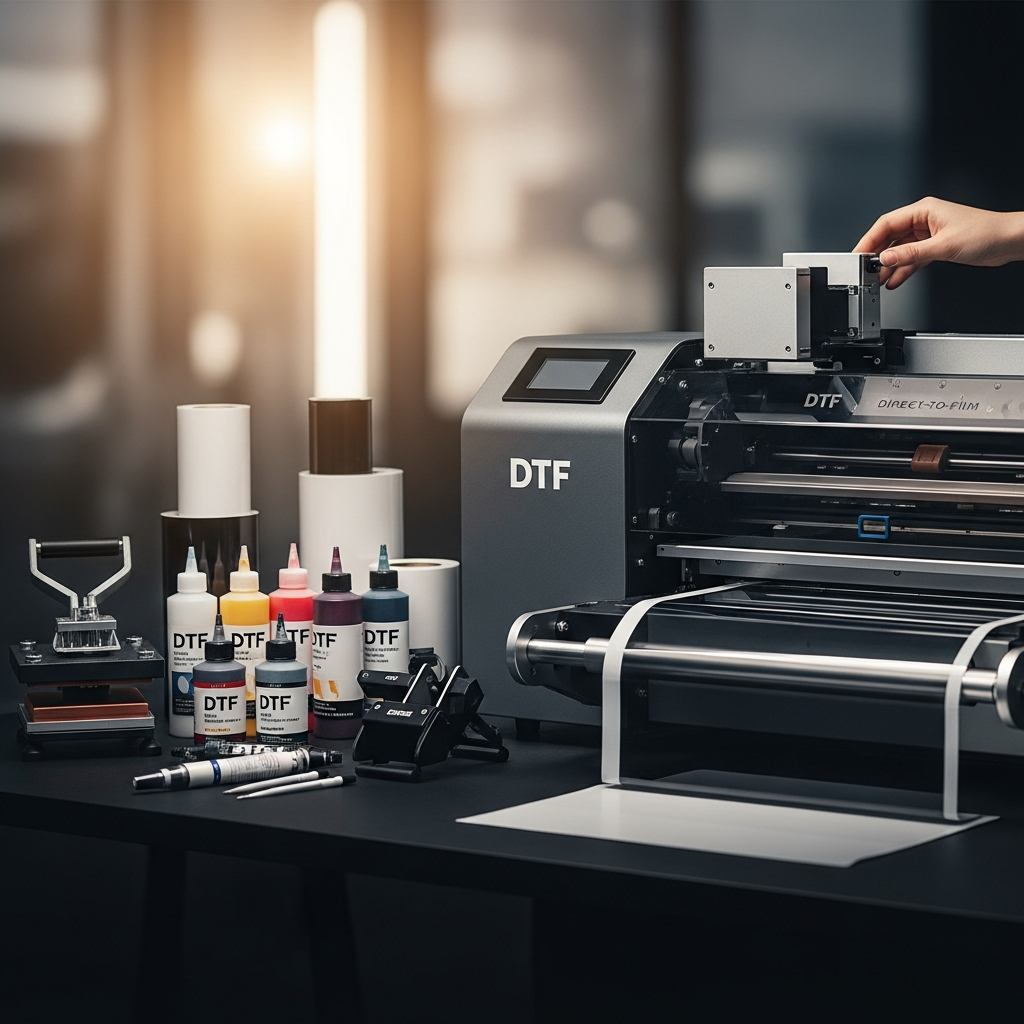
When you are looking to upgrade your print shop, choosing the right direct-to-film equipment is a major financial and operational decision. You want a machine that prints fast, stays reliable, and helps your business scale without creating new headaches. Reading the specification sheet is one thing, but understanding how these machines perform in a real production environment is what truly matters.
At American Print and Supply, we spend a lot of time on the floor with apparel decorators, installing machines, running training sessions, and optimizing workflows. Because of this hands-on approach, we hear exactly what business owners think about their equipment. To help you make an informed decision for your shop, we have compiled the general consensus and user reviews of popular DTF printer models currently leading the market.
For print shops that handle serious volume, speed and stability are the top priorities. The Kraken is our most advanced direct-to-film printer, featuring eight Epson I3200 print heads and output speeds of over 650 square feet per hour. It was built specifically to handle demanding production environments without compromising print quality.
Feedback from decorators running The Kraken consistently points to its sheer output capability and precision. Users often mention the dual rail magnetic drive system. Unlike traditional belt-driven machines, the magnetic drive eliminates belt drag, which keeps the print carriage stable even at maximum speeds. Shop owners report that this stability drastically reduces misprints and banding, saving them money on wasted film and ink.
Another major talking point in user reviews is the extended smart duster with a dual oven design. When a printer operates at 650 square feet per hour, the curing process needs to keep up. Operators appreciate that the powder is consistently melted and cured without having to slow down the printer to wait for the oven. They also highlight the ability to use up to 13 color combinations, including CMYK, RGBO, and dual white channels, which allows them to hit specific brand colors that standard four-color machines miss.
Based on user experiences, The Kraken is the right fit for established decorators and wholesale transfer providers who are maxing out their current equipment. If your team is constantly waiting on transfers to finish printing so they can start pressing, this machine eliminates that wait time.
Not every shop needs the massive output of an eight-head machine right away. For decorators who are scaling up from entry-level desktop machines, The Hydra hits the sweet spot. It features a robust six-head configuration that bridges the gap between mid-level printing and high-capacity industrial output.
When we look at user reviews of popular DTF printer models in the mid-to-high tier, The Hydra receives high marks for its balance of speed and footprint. Decorators note that it significantly outpaces four-head systems but remains manageable for a small team to operate. The integration with CADlink Digital Factory RIP software is frequently mentioned as a major positive. Users find that the software makes color profiling and job management straightforward, reducing the learning curve for new employees.
Shop owners also appreciate the heavy-duty build quality. Many reviews highlight the reliable white ink circulation system. White ink settling is a common issue in direct-to-film printing, leading to clogged print heads and downtime. Users report that The Hydra keeps the white ink agitated and flowing smoothly, which means less time spent running cleaning cycles and more time actually printing.
For businesses just bringing direct-to-film printing in-house, large industrial machines can be overwhelming. The Artemis and the UFO models are designed to offer commercial-grade reliability in a more compact, approachable format.
The Artemis is a two-head printer that operators praise for its simplicity. User reviews highlight that it produces the exact same print quality as the larger models, just at a slower pace. This makes it a perfect fit for custom apparel shops that focus on high-margin, low-volume orders or personalized gifts.
The UFO 24-inch plug-and-play printer is another favorite among newer decorators. Reviews frequently mention how easy it is to set up and maintain. Users love that they can pair it with an integrated smart duster and air purification system, like the Filtrabox Micro DTF Fume Extractor. This allows them to run the machine in standard retail spaces or smaller workshops without worrying about strong odors or ventilation issues.
One of the most interesting trends we see in user feedback is that once a shop upgrades to a fast printer, a new bottleneck appears: cutting the transfers. If your printer is outputting hundreds of transfers an hour, your staff cannot keep up with a pair of scissors.
To solve this, we introduced The Sentinel, a vision-based laser cutter built specifically for DTF transfers. Early feedback from decorators has been overwhelmingly positive. Users point out that they no longer have to mess with complicated DXF or CAD files. Because the overhead camera scans the printed rolls and maps the cut paths automatically, operators simply load the roll, press start, and let the machine work.
Reviews also praise the exit conveyor system. Staff can collect the cut transfers and take them straight to their Hotronix heat presses while the Sentinel continues cutting the next batch. It creates a continuous workflow that users say drastically reduces their labor costs.
Regardless of which machine a shop chooses, the most common theme in user reviews of popular DTF printer models revolves around support. The reality is that direct-to-film printing involves complex machinery, software, and chemistry working together. When something goes wrong, you need a partner, not just a manual.
We consistently hear from customers that the equipment itself is only half of the equation. What makes the real difference is the installation, the training, and the ongoing support. Whether you are running a two-head Artemis or an eight-head Kraken, having a technician come to your shop, set up the machine, dial in the color profiles, and train your staff is invaluable.
Decorators tell us that our white-glove service allows them to reclaim their time and peace of mind. Instead of spending weeks trying to figure out tension settings or adhesive powder application, they are pressing shirts and fulfilling orders on day one.
Choosing the right printer comes down to understanding your current volume, your growth goals, and your workflow. By looking at real user experiences, you can cut through the marketing noise and invest in the tools that will actually move your business forward.